Learning Studio / features
Classify objectives with framework levels
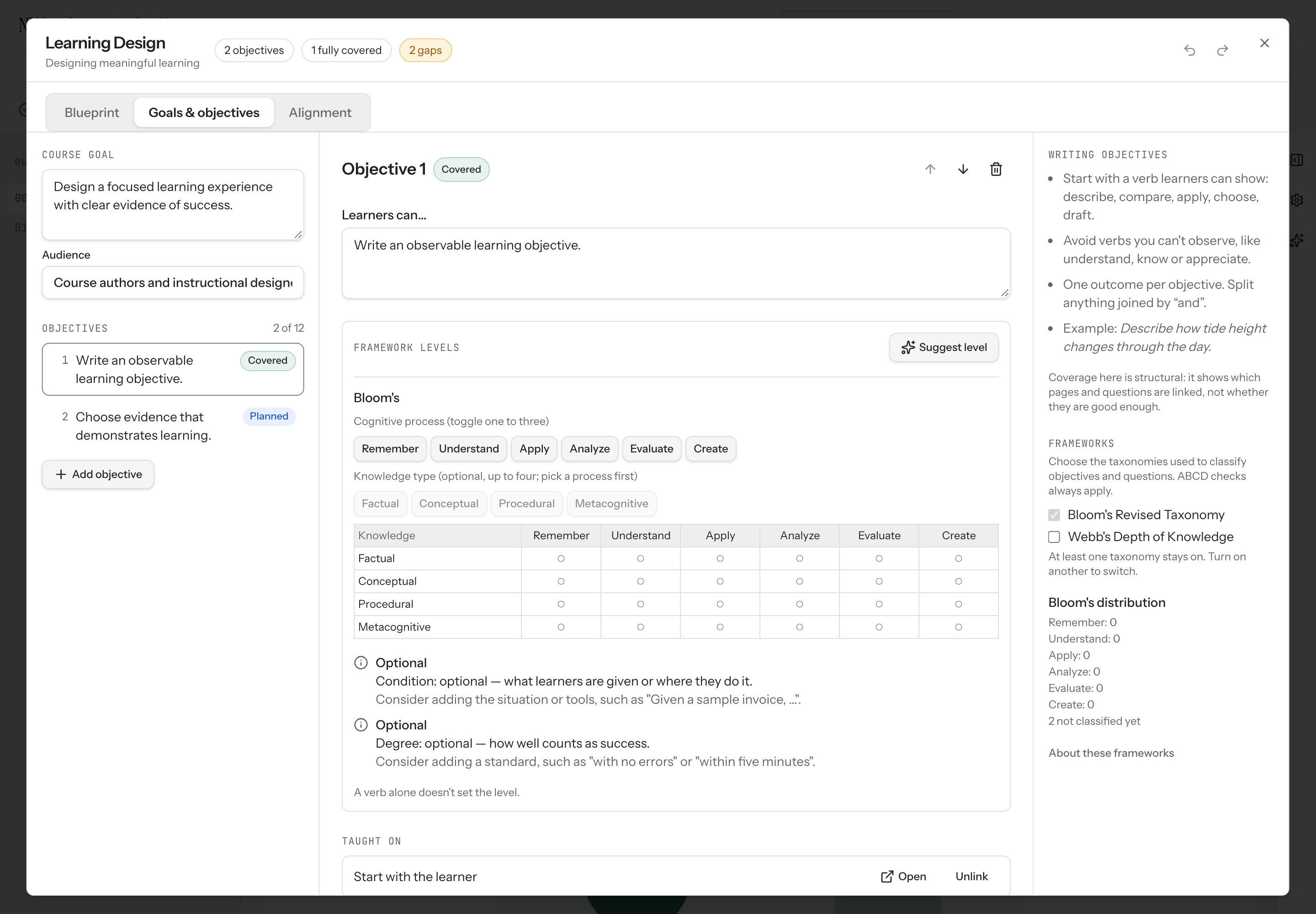
Set Bloom's Revised or Webb's Depth of Knowledge levels on objectives and questions, and use the ABCD wording checks.
Framework levels describe the kind of thinking an objective asks for. Setting them helps you notice when a course stays at recall, or when a question asks for less than the objective it checks.
For example, “List the steps of the refund process” asks learners to remember. “Choose the right refund for a customer’s situation” asks them to apply the process. A question that only asks for the list wouldn’t show that learners can make the choice.
Choose the frameworks for a course
Section titled “Choose the frameworks for a course”- Open Plan & review → Goals & objectives.
- Under Frameworks, select Bloom’s Revised Taxonomy, Webb’s Depth of Knowledge, or both.
New courses use Bloom’s Revised. At least one taxonomy stays on; to switch, turn on the other one first and then turn off the first. The ABCD wording checks always apply.
Choose About these frameworks to read a short summary of each framework, its sources, and when its descriptions were last checked.
Set an objective’s level
Section titled “Set an objective’s level”Select an objective in Goals & objectives. The Framework levels section shows an editor for each framework the course uses.
- Bloom’s: In the grid, choose one to three cognitive processes, from Remember to Create. You can also choose up to four knowledge types: Factual, Conceptual, Procedural, or Metacognitive. Pick a process before a knowledge type.
- DOK: Choose one level under Depth of knowledge, from DOK 1 · Recall to DOK 4 · Extended thinking.
Each level you choose shows its description and suggested verbs. The verbs are starting points only: a verb alone doesn’t set the level. Choose Clear to remove a framework’s level from the objective.
Each level shows who set it: Set by you, or AI suggestion you confirmed.
Ask for a suggested level
Section titled “Ask for a suggested level”- Write the objective’s wording first.
- Choose Suggest level. Choose Cancel if you want to stop waiting.
- Read each suggestion and its reasoning, then choose Use to apply it or Discard to leave it out.
Nothing changes until you choose Use, and you can undo an applied level with Ctrl/Cmd+Z. A suggestion is a reading of the wording, not a judgment about your learners. Check that the level matches what learners will actually do in the course.
Read the ABCD wording checks
Section titled “Read the ABCD wording checks”Under the levels, the objective’s wording is checked against the ABCD pattern: audience, behavior, condition, and degree.
- Worth fixing flags wording that’s hard to teach or check, such as a verb you can’t observe (“understand”, “know”) or an objective that joins more than one outcome.
- Optional suggests adding a condition, such as what learners are given, or a degree, such as how well counts as success.
Each check includes a suggested fix. The checks look at wording only; they can’t tell whether the objective fits your course.
Set a question’s level
Section titled “Set a question’s level”In an objective’s Assessed by list, each question has a level picker for each framework the course uses. Choose a level, or Not set to clear it. Locked quizzes can’t be changed.
When a question’s level is below the objective’s level, a warning appears under the question, for example: “A linked question is at Remember, below this objective’s Apply (Bloom’s).” Consider whether the question asks learners to do what the objective says.
Check the distribution
Section titled “Check the distribution”Beside the objective list, each framework shows how many objectives sit at each level and how many are not classified yet. If at least three objectives are classified and two-thirds or more sit at the lowest levels, a note reads “Most classified objectives sit at the lowest levels.” That can be right for an introductory course; use it as a prompt to decide whether learners also need to work at a higher level.
In Review
Section titled “In Review”Plan & review → Review includes Worth fixing wording checks, a low-level distribution, and question levels below their objective’s level as warnings. Selecting one opens Goals & objectives, at the objective when the warning is about one. These warnings don’t block anything.